We do not inherit the earth from our ancestors, we borrow it from our children
(Native American proverb).
Showing posts with label sustainability. Show all posts

Saturday, July 14, 2012

The perfect storm: food

The perfect storm may be just an expression, but for those caught in the midst of the event, it is far more serious than that.

I recently read an article on the Australian wine industry which described just such a problem. Generous government incentives, followed by massive over investment by the largest players, global competition, unfriendly exchange rates, and the regular lag time from investment to return now mean that I can get online and bid for a box of wine from $9. That's $0.75 per bottle, which I am certain is not making them very happy at all, considering the hard work that goes into these ventures.

Recently there have also been many stories of the impact that unsustainably low milk prices are having on dairy farmers, and how many are faced with bankruptcy if they do not sell out to the larger players in the industry, or foreign interests. At the root of this problem is the power of the supermarkets where two firms control over 80% of the domestic market. They cannot claim any foreign competition pressure. This is purely a race to the bottom of the price pile. Many a processing company has had to fight for shelf space, some of whom have significantly larger budgets than the small farming family with no commercial influence. What hope do these producers have?

Just this weekend, I was talking to a new friend who comes from out west, and he tells yet another story of the impact of foreign and corporate interests in our rural sector. With years of drought taking their toll on rural families, and governments attempting to control water resources, many have left their farms, and the most common purchasers of these holdings are yet again the foreign and corporate interests. Their goal is either rationalisation of small holdings into enterprises with economies of scale, AND/OR direct transfer export to overseas markets without value or margin adding. Net result in this scenario is the communities which had developed over centuries now gradually decline until they are a shadow of their former selves.

A sad and romantic sentiment it may be, however the diversity that once came from a dozen smaller family holdings allowed for a greater degree of resilience for city consumers. For when the market for one food commodity was low, other grains or livestock could be substituted relatively quickly, especially when not every farmer produced the same product. Today however the scale of operations in many of these regions, especially in more marginal areas, means the infrastructure is solely geared toward the production of one commodity. If that declines, then the speed at which a wide scale operation can be reconfigured is slow if not impossible. And if it doesn't decline, their buying capacity of water licences, resources and supplies gradually freezes out those smaller operators who remain.

I have not even mentioned the loss of domestic revenue when this process involves foreign interests.

Friends in the city, and those visiting from overseas I have heard repeatedly comment on the cost of food and living in this country. Ironic for such a vast land, that we pay so much for our basics of food and shelter. Shelter I have already dealt with, but our food is a real concern. As we gradually loose the diversity we should theoretically pay less as economies of scale kick in. Yet, diseconomies of scale seem to be increasingly prevalent.

Big is NOT better. Big distorts the market. Big thinks of themselves and shareholders first, not consumers and communities. How much harder do you work to keep 100 customers happy than you do to keep 100,000 happy. (don't take my word for it...) The loss of one is negligable for Big! Yet Big has more money to throw at political parties or candidates, advertising, research, etc. Surely there are more out there who can see the folly of Big!

And so the perfect storm begins. As we produce more and more of less and less; as our human capital on the land is lost; as we generate more income for less food; and as our control of our sovereign resources diminishes, we will increasingly risk yet another perfect storm. This time however it will not be a luxury product such as wine, but a staple. It may not be unobtainable, however the price we pay may just push the limits of what is sustainable.

To be continued...

Tuesday, July 10, 2012

All hail the golden arrow!

Ever seen "The Story of Stuff"? If not, while very simplistic, your understanding of this post will be enhanced by watching the clip first.

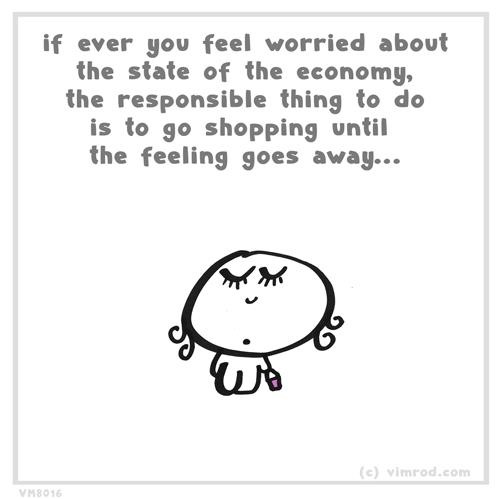
Now, with that in mind, we are all reliant upon money. As much as we try to take money out of our equation (have a look at my earlier post), it is undeniable that it is essential that we manage money, spending, and consumption as best we can. The problem is, most people tend to think along the lines of the following:

In a recent editorial, the Sydney Morning Herald identified one cause of a lack of consumer confidence in Australia has been the excessive level of household debt. Much of this debt has been attributed to the overblown housing market, but also significant has been the consumer debt from credit cards, store credit and other consumer credit sources. When the collective consciousness comes to the realisation (thanks to the Europeans and the Americans) that limitless economic growth cannot be achieved through continued retail spending, falling consumer confidence and a slowing retail sector result.

Aside from the issues of consuming consciously, with regard for ecological sustainability (this is NOT just a cliche'd slogan), or social justice issues, why do we consistently call on the retail therapist! My wife and I had a long conversation with our 10-year-old today, where we felt the need to defend our decisions about what we have chosen to surround ourselves with, materially speaking. While there is nothing like the questions of a pre-teen to sharpen and validate ones decisions, it brought focus to our drive to take money out of the equation, choosing to live with less, rather than enjoy all the spoils of living in a fortunate country.

Maybe if we all put a little more emphasis on quality of life rather than standard of living (Ron Laura's words, not mine) we might be happy to live on less, and enjoy some realistic, sustainable, fair and legitimate economic growth.

To be continued...

Tuesday, June 26, 2012

Big is not...

...better. What big is, is big! It is heavy, cumbersome, slow and proud. It crushes whatever is in its path and doesn't stop to survey the damage. Big doesn't react, it merely labours onward until the force of gravity slows its onward march and then it slowly turns around and goes back the other direction.

Big business is big in every way. Big doesn't care for the employee with cancer or their family. It doesn't know the struggles of its customers in any meaningful way. Big doesn't respond quickly to change, doesn't create from nothing, doesn't give without thought of self sacrifice. Big doesn't care for the loss of 100 customers the way small does; nor does it care for the needs of their suppliers, unless they too are big. It doesn't need to promote its virtues in any other way than big discounts, big volumes... and big margins. Big is excessive, wateful and more likely to corrupt and be corrupt.

Small on the other hand has to innovate, offers real choice, provides value rather than discounted price. Small cares for small and large alike; doesn't exert undue influence; doesn't have time to gloat or destroy its competitors or policy makers. It is the foundation of big, yet has not forgotten its roots like big can. Small creates, out of necessity and also out of choice. Small is the true source of competition, which is the basis of sustainability, efficiency and choice. Small may need some protection from big lest it be crushed by the momentum of cumbersome economic mass.

I'm not saying there isn't a place for big, but NOT at the expense of small. Big can have value when it acts small and doesn't use its weight to force conformity. Vote small with your words, your dollars and your choices, because one day you may be small too, and until then, small will add to our quality of life and true choice.

To be continued...

Saturday, June 16, 2012

Cities: a problematic paradigm of design

Our cities are spreading like a cancer into the regions that once sustained them. I recall as a child driving for mile after mile through productive farm land on my way to school. I never questioned where my food came from, and never expected that the huge expanse of urbanicity would one day consume all that had provided for me and my community as much as it had for those in the metropolis merely 60km away. Yet here we are. Those areas I once observed now only remain where insurance companies will refuse to cover in case of flood or fire. And it is not just the land of my childhood which has suffered a similar fate. Within sight of any of our ever expanding cities you will find the same picture. We have bought into a dream without an historical precedent, based on an inefficient allocation of scarce resources, in an era where the economic paradigm respects efficiency and intensity. It is the urban equivalent of supporting a low tech Australian consumer electronics industry, yet we defend it to the death because THIS is the great Australian dream.

Having bought into this misrepresentation of living standards, we realise something is fundamentally wrong with our present condition. Our response? rather than question the underlying design concept, we hanker for any small resemblance of the former paradigm. Enter the farmers market which now involves farmers travelling inefficiently vast distances in order to sell produce at highly inflated prices, not because their product is overpriced, but because they need to cover the ever increasing transport costs to bring their superior product to market. The alternative, growing your own produce in your ever shrinking backyard, street verge, roof top or balcony. And while this is also a move in the right direction, it ignores the fundamental flaw in the design: we have pushed our farmers away in a selfish desire to have a little (note, not a lot) more space to call our own.

With our trajectory set, the developers move in with big profits in their eyes, and a vested interest in maintaining the new status quo. Here lies a wonderful opportunity to cash in on the new bonanza of land and lifestyle, and inevitably dependence and a reduced quality of life. No, this is not a quantum leap in logic, merely a representation of the reality facing many Australian families, and perhaps families in many an industrialised country. With our patch of dirt, we bite off ever bigger pieces of economic dependence from financial institutions as our piece becomes a commodity to be traded in and upgraded, then downsized or subdivided.

With prices gradually moving beyond the reach of the average household, we sacrifice other elements of our lives in order to enter the fray, or at least, keep up with the trend. We first sacrificed our family model, and while much of the gains that were hard fought and won by the feminist movements of the 60s and 70s was rightly a fight for fairness in opportunity, it was also capitalised upon by that same developers who could see the benefit of it driving ever growing prices. But what happens when all the income a household can earn through their two or sometimes three incomes (often from two individuals or less) is still insufficient for the average house price? Enter the investor and the government handouts of negative gearing. If we want to discuss middle class welfare, one need not look any further than this. When government housing provided the safety net for renters, prices did not increase as rapidly as they have since it was wound back, and still it continued to push the affordability frontier beyond the average household. The USA provides us with a very clear demonstration of the consequences of this path, because even if we take out the effect of negative gearing, the drive to put people in suburban housing commodities eventually made it necessary for lending institutions to push the boundaries of sustainability and good business sense. Enter the sub prime time bomb.

Irony is everywhere in this model. In an attempt to continue the flawed rationale of the suburbs, we have laid the foundations of economic self destruction, design which is increasingly returning our suburbs to a false reality of space, and social fracture in the process. Sub prime loans are our evidence in the first instance, but what about the false reality of the spacious suburbs. With increasing affluence we have demanded larger homes and consumed more resources than ever before, and yet with our ever increasing wealth, why is it that our average land size in all major cities has fallen dramatically? It is yet another function of the failure of the entire suburban model. The ever increasing prices have pushed buyers out of the market, and therefore pushed developers into a volume race where each will outbid the other to maximise the return from each estate, not in terms of the price, but by reducing the size of the package they are selling, setting ever smaller average block sizes at relatively stable prices in order to continue the paradigm.

So what's next? Those who have realised they have been fooled by this false reality have sought to look further afield for REAL space. Enter the semi rural allotment. Have the space, and there certainly is space. And where can one find this space? None other than that rural urban fringe; the periphery where our sustaining food supplies once originated, or valuable conservation areas, or our open and public spaces. If we are willing to sacrifice our quality of life within the home in terms of the two full time incomes or two or more jobs per person, how much less will the collective consciousness care about such ethereal concepts as conservation or food miles, especially when we marvel at the size of our country or the effectiveness of our technology or transport. Who will subdivide further when faced with the continuing expansion of our cities into these peripheral areas? Will our new semi rural populations be as productive as our committed farmers? And if we are prepared to sacrifice this, then why not the rights of these new residents when the economic machine rolls on and discovers (or rediscovers) a more valuable resource in the same location? (Doubtless, the coal seem gas debate will continue to rage in this respect in Sydney at least!) Will we then say enough, or will it then be too late.

No, our chance is now. We need a moratorium on suburban expansion, and not just in our biggest cities, but in all our cities. Let cities be cities, and country be country. High density does not have to mean no green spaces. Country does not have to be so far away we can only access it for long weekend escapes. We have been sold the lie that we can have it all, but that is just not the case. Just as for every action in physics there is an equal and opposite reaction, so too is there a trade off in society. Often not in exactly the opposite direction, for society is too complex a beast to predict it so exactly, but the cost exists. It may be a health cost, an environmental cost, a cost in amenity, or security or in our very freedoms we hold so dear. No, our cost exists, and often it is not borne by those who create it. Does the mining magnate suffer the loss of their aesthetics when the fruits of their labour are constructed? Does the cost of the military contractor come back to the CEO or their family, or is it the price paid by the child soldier or the community destroyed by the wayward missile? This is not a conspiracy, but it is reality. It is vital that we all understand this reality so we might collectively act upon it and affect real change. Lets change the paradigm of design to reflect a more stable and equitable reality.

To be continued...

Wednesday, January 12, 2011

Stuff

How much stuff can one family accumulate? I think that we live fairly frugally compared to many of our peers, yet even with an attitude of limited accumulation, we still have so much stuff. What drives us to gather, collect, store (and this alone is a crazy, illogical rationale... it's the "I'll keep because I just never know when I might need it" voice in your head!) and protect our stuff, much of which we never use, and rarely take time to appreciate.

We are downsizing. On the surface it looks like a pretty straightforward shift... 3 bedroom house on the Coast for a 4 bedroom cottage in the southern tablelands. Then you look at the rooms. This "cottage" is actually half of a converted shearers quarters. The main bedroom looks like it has been created by dividing the lounge/dining room. Another looks like it was a veranda until it needed to be a bedroom. The third is barely big enough for a queen size bed, and the last, well I'm sure it was a closet in a past life. I'm not becrying our choice of residence; we wanted to downsize; but it is quite a bit smaller than where we are now. I'm quite pleased we decided to go this way however as we are now in the throws of being a little ruthless in getting rid of some of our useless "stuff."

This brings me to my second jaw dropper... who wants my old stuff? Surely the various charities would want it. There's the old TV which we are getting rid of because I couldn't bare to let me father throw out his flat screen CRT digital TV when he upgraded to a slim LCD model (which has just broken down mind you after 18 months!); there's perfectly good books which we have read and are quite useful but which no one seemed to look twice at during our garage sale; there's fabric remnants from my wife's sewing kitty which could make some great crafty goods or clothes or bags; and then there's odd bits of furniture... NO ONE WANTS THEM! Are we that wealthy as a community that even our poorest members of society can afford an LCD TV? Does no one read books any more? Is hand made just plain old fashioned? I KNOW people sit on stools still!

I have a new year's resolution: until now, when my wife would stop on the side of the road and ask me to get out and collect some old chair/suit case/stool/cabinet/ladder/etc... I would do so with the usual grumblings and self consciousness associated with a dust man rummaging through the garbage on Pitt St. No More! From now on, I will do so with joy, secure in the knowledge that at least I can be the difference I want to see in the world.

Until then, it's back to packing up our stuff.

earthkeeper

ps if you want to hear more about "Stuff" check out www.storyofstuff.com

Tuesday, January 4, 2011

Why would you leave The Coast?

My love for country living began as a child, growing up in the Blue Mountains. We had chooks (far too many for our own needs) a couple of jersey cows, goats at one time, a couple of sheep we inherited from Uncle Kevin in Glenn Innes, plenty of fruit trees and a vege patch. Sunday was work day on the small acreage my father decided to call Tallowood Farm, and barely a weekend went by when we didn't spend much of our time walking the paddocks to pull out fireweed or pattersons curse, sitting by the creek when it ran, chasing then catching and riding the sheep (easy to do when their fleece is long and you're a 10 year old boy), digging manure, or the garden or chasing a wayward sheep out of the living room where their favourite dish was mum's ornamental indoor plants. There was lots of hard work, but so much joy when looking back.

These memories are not all rose tinted as anyone growing up outside of suburbia would know, but they are ones that I would wish for my children. There were bushfires, droughts, floods (actually, I liked the floods as a kid - no school!), fetching wayward goats who seem to be able to escape through the smallest hole in a fence... But on balance, it is amazing how easy it is to remember the good times, and forget the tough times. This week our books are packed away ready for our move, so we have resorted to recounting stories from our childhood for our two boys at bed time. They sit transfixed by the tales of coming off horses or motorbikes, getting hit by cars or cows, chasing sheep out of the house, etc... and I cannot help but wonder what stories they will tell to their kids.

Fortunately I found in my wife a kindred spirit and we have been working, sometimes harder than others, at achieving the goal of a tree change for our own family. However it has not been the same dream all the time. We initially thought the Hunter Valley would be our ideal home; a brief thought for the Yarra Valley and Tasmania; the Southern Highlands when we felt rich enough, or a scrubby block waiting to be discovered in the Wollombi valley when we weren't. Sometimes we envisaged a grand residence, complete with artist studio and gallery space, while others we saw a fully self sufficient, environmentally sustainable cottage made out of mud brick, rammed earth or straw bales. The binding factors were the ones mentioned in my last post, and the memories that can only be created in rural settings.

Philosophically speaking, our world view sees the western culture as far too materialistic and consumer driven, and with all the symptoms of Oliver James' Affluenza surrounding us, we have a great yearning to leave the ease of that lifestyle for the closer connections with the earth, regardless of how difficult that may be at times. There seems to be a greater emphasis on community and simpler, slower living; sharing our excess in the good times, and supporting each other in the bad; the muse of poets, musicians and artists is often adversity where it inspires creativity, ingenuity and simpler pleasures; and finally there's the food... well, need we justify being closer to our food sources?

In short, and to answer the question, if the coast could provided all this, maybe we wouldn't leave... but what an exciting journey it will be stepping outside our comfort zone.

earthkeeper

Monday, January 3, 2011

2011 is the year...

...for turning dreams into reality.

The Dream:
To have a farm, in the traditional sense, with a variety of outputs from eggs, pork, beef, olives, and of course wine, in a rural community where my family and I could practice the principles we have always strived to live by. To slow life down and live rather than exist. Find a place to be... to be me; to be free; to be free from the overdeveloped consumer-driven society which is slowly killing us and our culture... but i digress.

Our requirements:
We want to be within 4 hours of the central coast (family and friends from the past 10 years are there), within 2 hours of a major city, within 3 hours of Sydney (for our Sydney fix) in a region capable to producing good wine and olive oil, and with land we can afford without selling our souls to the machine which is modern economic rationalism.

There were other ideals... green rolling hills (okay so that's Tasmania and the NSW south coast... not gonna happen!), a stony creek, a vibrant arts community, a degree of multiculturalism, and some foodies nearby...

Fast forward to November 2010, and after years of waiting, researching, looking, visiting different areas and almost applying for several jobs, the ideal opportunity arises. Just 11 months after deciding that we'll stay put in our suburban life until our 3 year old starts school, a spanner gets well and truly thrown into the works and the resultant roller coaster of the past 2 months has been a giddy thing (Mumford and sons gave me that last line as I write).

My next few posts will be dealing with the past 2 months as we pack up our suburban lives and prepare to move to the country for a new life, with new possibilities and new challenges, but with an expectation of a reality quite different from our present reality. Also, for anyone who has ever read one of my previous posts will attest, I also plan to reinvent my blog as a journal of discovery which is quite a different direction from the old righteous indignation at the state of the world.

I do hope that you will join me on my journey...

earthkeeper.

Thursday, August 5, 2010

On Washing Machines and Free TVs

My last post made me dredge up an old, unpublished post from four months ago... still relevant!

Our 4 year old washing machine is dead! Aside from the considerable annoyance it has caused it has also made me quite angry about the state of our modern lifestyle and the impact it is having on our planet. Before I dug out the warranty papers (thank God for extended warranty options!), I looked around to see what a new one was worth, what features they had before I had to make an informed decision about whether to "buy new" or "repair". The thing that really got to me was that LG had a special promotion where you could get a free LCD TV with every purchase of a new front loader... imagine that; a free TV. Now I could get rid of that heavy CRT thing that I inherited from my parents when they upgraded their TV to the latest Sony LCD.

The math was easy to interpret: repair it for $500 (actually $0 because of the warranty) or get a new washer PLUS a TV for $400 (the price of the new unit LESS the warranty payment), complete with a new warranty, latest bells and whistles, and a sense of satisfaction that we FINALLY had a slim TV that would sit on the wall and not a reinforced TV unit. Say nothing of the fact that not one but two old units would have to be thrown out; I guess we could keep the TV for our bedroom, and give the old, old TV that was replaced by the last TV to our kids so that they too can watch countless hours of TV or play DVDs or computer games in their room instead of physically exerting themselves or (heaven forbid) interacting with other people in a social context where they would have to use their creativity and ingenuity to come up with a new game together, or communicate effectively... sorry, I digress.

Seriously, what has our culture come to when it becomes easier to just discard so we can get the latest and greatest, or chain ourselves to our houses, or add to the wasteful consumption that is western society. Something has got to give!

earthkeeper

Monday, January 18, 2010

To be an Earth Keeper...

As early as I can remember I have been passionate about the planet; sometimes overtly when marching in protest of a development or logging old growth forests; sometimes just in my belief that a slower pace of life and old fashioned foods and lifestyles are not only better for you personally, but collectively. I've written passionately about conservation in university papers, been a member of several environmental groups at one time or another and even voted Australian Greens. I loved Midnight Oil, took Geography at school, then studied it again at university. Taught teenagers in high school how to be aware, take care, and share information that would create a better future than the one they inherited from their parents.

Then I forgot! I forgot to care; forgot to be an agent of change for sustainable living or social justice. I became intent on making it (whatever "it" was); of making my fortune and then living on my estate enjoying my due rewards. Seduced by the all powerful, all important dollar. Lured by the promise of a full and extravagant life of parties and travel and cars and real estate, fine wines, fine foods, classy hotels and fame.

I'm not exactly sure what the tipping point was, but 2009 was a watershed year for me. I had been teaching Business Studies and running a small business with my wife for years, and I was ready for a change; seeking a shift to the country to find myself and give my beautiful wife and boys a slower paced and more peaceful life. I thought we could live off the land and leave our lives behind. It was all about me, and even though my motives were better, they were still inward looking.

We have always had a passion for cooking, good food and wine, enjoyed the search for quality produce and farmers markets, and were looking for the perfect region for our resettlement program, all the while watching family and friends slowly accumulate more and more while having less and less time for those they loved. It finally came down to 3 things:
  1. My wife and I went to the USA for a friends wedding, and while we had an amazing experience, we saw American capitalism at work first hand with its strip malls, huge fuel guzzling cars (and trucks!) food servings to feed a small village, and cities (New York in particular with it's bitter-sweet lifestyle) which had life but no ecology, and while we would love to return, were also acutely aware of what we didn't want our planet to resemble in 100 years time;
  2. A good friend and colleague invited me to help her fulfill a dream of creating a school garden which we could use to encourage our students and their families to be actively involved in growing food for themselves and their families, as well as being a practical application of theories we were teaching every day. Instantly I saw it as a way of achieving my self sufficiency goals in an environment where food prices going through the stratosphere, fuel prices at historically high levels, economic uncertainty and one of the worst droughts in Australia's history;
  3. Whilst researching markets for my wife to sell her hand crafted wares, we came across a kitchen garden project being run by CarriageWorks performance space in Sydney. We attended the launch in which they played the documentary "The Power of Community: How Cuba Survived Peak Oil", among other speakers relating their experiences in their goal of achieving a more sustainable future for themselves and our wider community. At this point something inside me turned on, like a culmination of all previous learning, beliefs, experiences and goals had been leading to this point. I applied to be involved in the workshop and was selected. What I have learned since will be the point of future blogs.

Today, I write as one who treasures life, in all it's intricacies, forms and relationships. I am an environmentalist, and as such I believe that life is is intricate web of systems, both biophysical and human, and to disregard one would be to the peril of others. I am about living sustainably, so that everyone from my grandchildren through to their great grandchildren and beyond will live in a world which allows them to have a quality of life as good as our own, and not, as Ron Laura suggests, living in a way which inadvertently sacrifices our quality of life for our standard of living. I am about community and our collective responses to the challenges which face us. Through collective action we can, as Paul Hawken calls it, be a part of the earth's immune response system to ecological decay, economic disease, political corruption and social dysfunction. These are the aims and duties of an earth keeper; a steward of an earth we have borrowed from our children, rather than an earth we have inherited from our ancestors. I look forward to sharing my thoughts and hearing yours.