We do not inherit the earth from our ancestors, we borrow it from our children
(Native American proverb).
Showing posts with label Quality of Life. Show all posts

Tuesday, July 10, 2012

All hail the golden arrow!

Ever seen "The Story of Stuff"? If not, while very simplistic, your understanding of this post will be enhanced by watching the clip first.

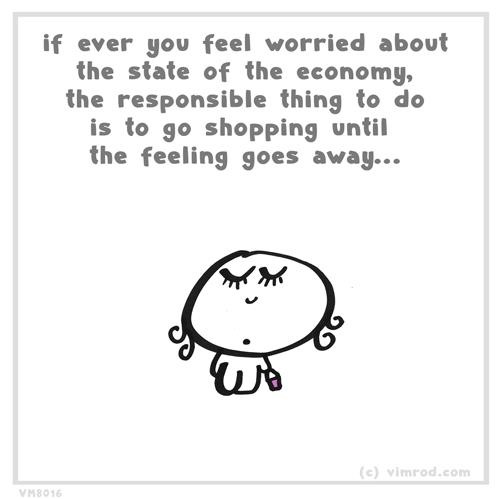
Now, with that in mind, we are all reliant upon money. As much as we try to take money out of our equation (have a look at my earlier post), it is undeniable that it is essential that we manage money, spending, and consumption as best we can. The problem is, most people tend to think along the lines of the following:

In a recent editorial, the Sydney Morning Herald identified one cause of a lack of consumer confidence in Australia has been the excessive level of household debt. Much of this debt has been attributed to the overblown housing market, but also significant has been the consumer debt from credit cards, store credit and other consumer credit sources. When the collective consciousness comes to the realisation (thanks to the Europeans and the Americans) that limitless economic growth cannot be achieved through continued retail spending, falling consumer confidence and a slowing retail sector result.

Aside from the issues of consuming consciously, with regard for ecological sustainability (this is NOT just a cliche'd slogan), or social justice issues, why do we consistently call on the retail therapist! My wife and I had a long conversation with our 10-year-old today, where we felt the need to defend our decisions about what we have chosen to surround ourselves with, materially speaking. While there is nothing like the questions of a pre-teen to sharpen and validate ones decisions, it brought focus to our drive to take money out of the equation, choosing to live with less, rather than enjoy all the spoils of living in a fortunate country.

Maybe if we all put a little more emphasis on quality of life rather than standard of living (Ron Laura's words, not mine) we might be happy to live on less, and enjoy some realistic, sustainable, fair and legitimate economic growth.

To be continued...

Saturday, June 16, 2012

Cities: a problematic paradigm of design

Our cities are spreading like a cancer into the regions that once sustained them. I recall as a child driving for mile after mile through productive farm land on my way to school. I never questioned where my food came from, and never expected that the huge expanse of urbanicity would one day consume all that had provided for me and my community as much as it had for those in the metropolis merely 60km away. Yet here we are. Those areas I once observed now only remain where insurance companies will refuse to cover in case of flood or fire. And it is not just the land of my childhood which has suffered a similar fate. Within sight of any of our ever expanding cities you will find the same picture. We have bought into a dream without an historical precedent, based on an inefficient allocation of scarce resources, in an era where the economic paradigm respects efficiency and intensity. It is the urban equivalent of supporting a low tech Australian consumer electronics industry, yet we defend it to the death because THIS is the great Australian dream.

Having bought into this misrepresentation of living standards, we realise something is fundamentally wrong with our present condition. Our response? rather than question the underlying design concept, we hanker for any small resemblance of the former paradigm. Enter the farmers market which now involves farmers travelling inefficiently vast distances in order to sell produce at highly inflated prices, not because their product is overpriced, but because they need to cover the ever increasing transport costs to bring their superior product to market. The alternative, growing your own produce in your ever shrinking backyard, street verge, roof top or balcony. And while this is also a move in the right direction, it ignores the fundamental flaw in the design: we have pushed our farmers away in a selfish desire to have a little (note, not a lot) more space to call our own.

With our trajectory set, the developers move in with big profits in their eyes, and a vested interest in maintaining the new status quo. Here lies a wonderful opportunity to cash in on the new bonanza of land and lifestyle, and inevitably dependence and a reduced quality of life. No, this is not a quantum leap in logic, merely a representation of the reality facing many Australian families, and perhaps families in many an industrialised country. With our patch of dirt, we bite off ever bigger pieces of economic dependence from financial institutions as our piece becomes a commodity to be traded in and upgraded, then downsized or subdivided.

With prices gradually moving beyond the reach of the average household, we sacrifice other elements of our lives in order to enter the fray, or at least, keep up with the trend. We first sacrificed our family model, and while much of the gains that were hard fought and won by the feminist movements of the 60s and 70s was rightly a fight for fairness in opportunity, it was also capitalised upon by that same developers who could see the benefit of it driving ever growing prices. But what happens when all the income a household can earn through their two or sometimes three incomes (often from two individuals or less) is still insufficient for the average house price? Enter the investor and the government handouts of negative gearing. If we want to discuss middle class welfare, one need not look any further than this. When government housing provided the safety net for renters, prices did not increase as rapidly as they have since it was wound back, and still it continued to push the affordability frontier beyond the average household. The USA provides us with a very clear demonstration of the consequences of this path, because even if we take out the effect of negative gearing, the drive to put people in suburban housing commodities eventually made it necessary for lending institutions to push the boundaries of sustainability and good business sense. Enter the sub prime time bomb.

Irony is everywhere in this model. In an attempt to continue the flawed rationale of the suburbs, we have laid the foundations of economic self destruction, design which is increasingly returning our suburbs to a false reality of space, and social fracture in the process. Sub prime loans are our evidence in the first instance, but what about the false reality of the spacious suburbs. With increasing affluence we have demanded larger homes and consumed more resources than ever before, and yet with our ever increasing wealth, why is it that our average land size in all major cities has fallen dramatically? It is yet another function of the failure of the entire suburban model. The ever increasing prices have pushed buyers out of the market, and therefore pushed developers into a volume race where each will outbid the other to maximise the return from each estate, not in terms of the price, but by reducing the size of the package they are selling, setting ever smaller average block sizes at relatively stable prices in order to continue the paradigm.

So what's next? Those who have realised they have been fooled by this false reality have sought to look further afield for REAL space. Enter the semi rural allotment. Have the space, and there certainly is space. And where can one find this space? None other than that rural urban fringe; the periphery where our sustaining food supplies once originated, or valuable conservation areas, or our open and public spaces. If we are willing to sacrifice our quality of life within the home in terms of the two full time incomes or two or more jobs per person, how much less will the collective consciousness care about such ethereal concepts as conservation or food miles, especially when we marvel at the size of our country or the effectiveness of our technology or transport. Who will subdivide further when faced with the continuing expansion of our cities into these peripheral areas? Will our new semi rural populations be as productive as our committed farmers? And if we are prepared to sacrifice this, then why not the rights of these new residents when the economic machine rolls on and discovers (or rediscovers) a more valuable resource in the same location? (Doubtless, the coal seem gas debate will continue to rage in this respect in Sydney at least!) Will we then say enough, or will it then be too late.

No, our chance is now. We need a moratorium on suburban expansion, and not just in our biggest cities, but in all our cities. Let cities be cities, and country be country. High density does not have to mean no green spaces. Country does not have to be so far away we can only access it for long weekend escapes. We have been sold the lie that we can have it all, but that is just not the case. Just as for every action in physics there is an equal and opposite reaction, so too is there a trade off in society. Often not in exactly the opposite direction, for society is too complex a beast to predict it so exactly, but the cost exists. It may be a health cost, an environmental cost, a cost in amenity, or security or in our very freedoms we hold so dear. No, our cost exists, and often it is not borne by those who create it. Does the mining magnate suffer the loss of their aesthetics when the fruits of their labour are constructed? Does the cost of the military contractor come back to the CEO or their family, or is it the price paid by the child soldier or the community destroyed by the wayward missile? This is not a conspiracy, but it is reality. It is vital that we all understand this reality so we might collectively act upon it and affect real change. Lets change the paradigm of design to reflect a more stable and equitable reality.

To be continued...

Tuesday, January 4, 2011

The role of Money and our Tree Change

"Money is the root or all evil" is the often misquoted verse from the Bible, which actually says the "love" of money is the root of all evil. It does however play a significant role in our lives at this time of preparing for our tree change. I have oscilated between radical adoption of this phrase as a mantra for my life, and a sceptical disbelief in its central idea; but in retrospect, it has been a very real part of our journey.

Several years ago we were broke, or very nearly. Our business of 8 years was sinking fast; my wife who was the intellectual property behind the business was very ill and things were grim. For the best part of a year we struggled like you wouldn't wish on anyone, and often during this time vowed and declared that we would never again be in the position. I had wanted to build a large business out of our humble photography studio, franchising my wife's good name and artistic abilities to the end of living a jet setting lifestyle, all run out of our Hunter Valley vineyard. Even as we went through the worst of our PFC (personal financial crisis) i thought the answer would lie in earning our way out of it, then we could just step straight back into those dreams once more.

I should digress at this point and mention that 10 years earlier I was radically opposed to the whole capitalist system. I was anti big business, an active environmentalist and considering pursuing such ideals in a political sense. I had studied to be a Geography teacher to help educate the future generations in the ways of harmony with the earth and the power of community, and really only chose to to minor in the field of Economics because I disliked it least from a list of subjects I would need to get a job in NSW schools. Ironically my first teaching position was to teach Business Studies, and the path was set for the next 10 years in my gradual transition to idealise and aim for the very thing I had derided as a student.

Our PFC did not go away quickly. we struggled on, stressed and discouraged. We wanted another child (in fact we had talked early in our relationship about 4 or 6 kids) but couldn't fall pregnant. We couldn't afford IVF and weren't really sure that we wanted to go down that path, when finally we decided to just surrender to our situation and enjoy what we had. My wife left her job managing an event decoration business and went back to Uni; I worked in a school I enjoyed working in again; and you can probably guess what happened next...

...back to one income. Now, however we had to make some serious decisions about what was best for our own family, health, finances and future. At this point we were both journalling many thoughts and finally sat down to compare notes, only to discover a deep yearning to live a better quality of life, rather than a have a better standard of living. We also decided to make sure that in so doing we were not inadvertently compromising that of others in our own country or around the world. Our kitchen blackboard, which often carried inspiring sayings (as well as our weekly menu), suddenly carried some rather poignient messages including:

"Live Consciously" (which now appears on a range of tote's my wife creates)
"Be yourself, everybody else is taken" (from the song by Melinda Schneider)
"There is no pleasure in the finest cloth if it causes hunger and unhappiness" (Gandhi), and
"TAKE MONEY OUT OF THE EQUATION"

It's funny how once you verbalise something enough, it becomes a part of you. I started to struggle teaching Business Studies when so many of the case studies I had used were only about money, and how much you could make; we started to be more focussed on providing for ourselves again by growing more and more of our own food; we began spending more on products that had been made locally, or by friends, or in ethical and environmentally sustainable ways; my wife started sewing again and worked on producing art or craft items for art sake, selling some to help make ends meet; and things started changing in our lives. Of course it took a casual conversation with our landlord one afternoon as he fixed some drawers in the kitchen for us to realise just how far we'd come. As he listened to our stories and chatted about life, he remarked that it seemed to him that we had already taken money out of the equation in how we lived our lives.

The final step was to voluntarily take a step back in my career, along with a pay cut, in order to really focus on family, learning, creating and working on our now renewed dream of country living. The irony: merely 2 months after giving notice of stepping down from my management position, all the things that I had been searching for in order to make our dream a reality started occurring in rapid succession: not one but three job vacancies in country schools which were in the vicinity of where we wanted to be; travel plans which involved visiting one of the towns I was to interview for en route to my sister-in-law's 40th birthday party celebrations; a great interview and supportive principals in both schools; a cottage on a farm in our price range, with a landlord willing to wait longer than we could have hoped for in a market where properties were scarce. Money was not the enabler, if anything it limited our imagination, stifled our creativity and served to lower our quality of life.

Now, I'm not suggesting that we can live without money altogether. On the contrary. It is a necessary evil. But when we allow ourselves to live free of money's stress, we open doors and ideas and relationships which are worth far more than the money could ever have provided.

Forget the "Show me the money!" or "Greed... is good; greed works" promises of a happiness that lasts. I say take money out of the equation.

earthkeeper

Wednesday, July 28, 2010

Reclaim Your World

Food security is soemthing almost as foreign to us Australians as rabid dogs, yet at the CarriageWorks Kitchen Garden Project launch last September I was confronted with a very plausable reality: we are only three days away from hunger! Pesimistic it may be, but the fact remains that we are SO reliant on our economic systems that we are literally enslaved to them to the point of having our very survival compromised should the external shock be significant enough.

Dont' believe me, check out the doco "The Power of Community: How Cuba Survived Peak Oil" at www.powerofcommunity.org and see how easy it was for Cuba to have their physical survival compromised by forces very much beyond their control.

Now I'm not a conspiracy theorist, nor am I a pesimist by nature, but I am concerned about my ability to withstand the externalities associated with decisions made by faceless men in foreign lands upon my quality of life. The powerlessness that invokes is enough to make me question the wisdom of the global village in which we live. Surely our local village would not be so quick to condemn us to servitude, poverty and ruin as they would have to face us each an every day, yet our global village has the advantage of distance. We are only as close to our global villagers as our telecommunications allow us to be, yet we can also be a world away at the flick of the proverbial switch.

I cannot accept a world where my livelihood, my quality of life, even my very survival can be determined in a board room on the other side of the world and then ignore my oposition by disconnecting their internet link or cable network. The countries of the North have been doing it to the majority world for centuries, but in this era of rapid communication and global webs the speed at which this can just as easily be applied to any one of us at any given point in time. Human evolution may just have gone too far!

What do we do? Reclaim what is ours! It is our life, our world and our future, why can't we claim it. I think it is time for us to take back our sovereignty and take charge of what is rightly ours. Sure, globalisation has led to massive improvements in life expectancy, biomedical science, unprecedented wealth for some of us, but maybe we have won this glorious prize of human ingenuity which is a high standard of living at the expense of our quality of life... and in the process forgotten the difference!

As an EarthKeeper I would like to be practical in my attempts to wind back the perils of progress and suggest some ways we can all take control of our lives, not leaving decisions to multinational corporations and their puppet governments (lets face it, many of them are! Just look at how much power BHP and Rio Tinto can have over a "successful" government such as Australia's). My pledge is to give share some ideas I have on achieving these ends, and hopefully to hear some of your ideas to the same end.

Reclaiming the earth for all keepers and not simply those who would mine its very soul,
EarthKeeper