We do not inherit the earth from our ancestors, we borrow it from our children
(Native American proverb).

Saturday, July 14, 2012

The perfect storm: food

The perfect storm may be just an expression, but for those caught in the midst of the event, it is far more serious than that.

I recently read an article on the Australian wine industry which described just such a problem. Generous government incentives, followed by massive over investment by the largest players, global competition, unfriendly exchange rates, and the regular lag time from investment to return now mean that I can get online and bid for a box of wine from $9. That's $0.75 per bottle, which I am certain is not making them very happy at all, considering the hard work that goes into these ventures.

Recently there have also been many stories of the impact that unsustainably low milk prices are having on dairy farmers, and how many are faced with bankruptcy if they do not sell out to the larger players in the industry, or foreign interests. At the root of this problem is the power of the supermarkets where two firms control over 80% of the domestic market. They cannot claim any foreign competition pressure. This is purely a race to the bottom of the price pile. Many a processing company has had to fight for shelf space, some of whom have significantly larger budgets than the small farming family with no commercial influence. What hope do these producers have?

Just this weekend, I was talking to a new friend who comes from out west, and he tells yet another story of the impact of foreign and corporate interests in our rural sector. With years of drought taking their toll on rural families, and governments attempting to control water resources, many have left their farms, and the most common purchasers of these holdings are yet again the foreign and corporate interests. Their goal is either rationalisation of small holdings into enterprises with economies of scale, AND/OR direct transfer export to overseas markets without value or margin adding. Net result in this scenario is the communities which had developed over centuries now gradually decline until they are a shadow of their former selves.

A sad and romantic sentiment it may be, however the diversity that once came from a dozen smaller family holdings allowed for a greater degree of resilience for city consumers. For when the market for one food commodity was low, other grains or livestock could be substituted relatively quickly, especially when not every farmer produced the same product. Today however the scale of operations in many of these regions, especially in more marginal areas, means the infrastructure is solely geared toward the production of one commodity. If that declines, then the speed at which a wide scale operation can be reconfigured is slow if not impossible. And if it doesn't decline, their buying capacity of water licences, resources and supplies gradually freezes out those smaller operators who remain.

I have not even mentioned the loss of domestic revenue when this process involves foreign interests.

Friends in the city, and those visiting from overseas I have heard repeatedly comment on the cost of food and living in this country. Ironic for such a vast land, that we pay so much for our basics of food and shelter. Shelter I have already dealt with, but our food is a real concern. As we gradually loose the diversity we should theoretically pay less as economies of scale kick in. Yet, diseconomies of scale seem to be increasingly prevalent.

Big is NOT better. Big distorts the market. Big thinks of themselves and shareholders first, not consumers and communities. How much harder do you work to keep 100 customers happy than you do to keep 100,000 happy. (don't take my word for it...) The loss of one is negligable for Big! Yet Big has more money to throw at political parties or candidates, advertising, research, etc. Surely there are more out there who can see the folly of Big!

And so the perfect storm begins. As we produce more and more of less and less; as our human capital on the land is lost; as we generate more income for less food; and as our control of our sovereign resources diminishes, we will increasingly risk yet another perfect storm. This time however it will not be a luxury product such as wine, but a staple. It may not be unobtainable, however the price we pay may just push the limits of what is sustainable.

To be continued...

Tuesday, July 10, 2012

All hail the golden arrow!

Ever seen "The Story of Stuff"? If not, while very simplistic, your understanding of this post will be enhanced by watching the clip first.

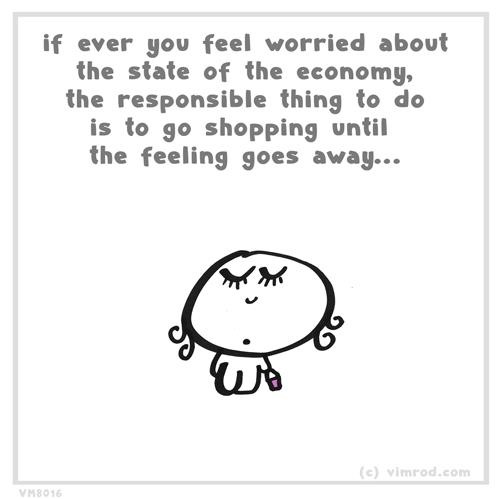
Now, with that in mind, we are all reliant upon money. As much as we try to take money out of our equation (have a look at my earlier post), it is undeniable that it is essential that we manage money, spending, and consumption as best we can. The problem is, most people tend to think along the lines of the following:

In a recent editorial, the Sydney Morning Herald identified one cause of a lack of consumer confidence in Australia has been the excessive level of household debt. Much of this debt has been attributed to the overblown housing market, but also significant has been the consumer debt from credit cards, store credit and other consumer credit sources. When the collective consciousness comes to the realisation (thanks to the Europeans and the Americans) that limitless economic growth cannot be achieved through continued retail spending, falling consumer confidence and a slowing retail sector result.

Aside from the issues of consuming consciously, with regard for ecological sustainability (this is NOT just a cliche'd slogan), or social justice issues, why do we consistently call on the retail therapist! My wife and I had a long conversation with our 10-year-old today, where we felt the need to defend our decisions about what we have chosen to surround ourselves with, materially speaking. While there is nothing like the questions of a pre-teen to sharpen and validate ones decisions, it brought focus to our drive to take money out of the equation, choosing to live with less, rather than enjoy all the spoils of living in a fortunate country.

Maybe if we all put a little more emphasis on quality of life rather than standard of living (Ron Laura's words, not mine) we might be happy to live on less, and enjoy some realistic, sustainable, fair and legitimate economic growth.

To be continued...

Tuesday, June 26, 2012

Big is not...

...better. What big is, is big! It is heavy, cumbersome, slow and proud. It crushes whatever is in its path and doesn't stop to survey the damage. Big doesn't react, it merely labours onward until the force of gravity slows its onward march and then it slowly turns around and goes back the other direction.

Big business is big in every way. Big doesn't care for the employee with cancer or their family. It doesn't know the struggles of its customers in any meaningful way. Big doesn't respond quickly to change, doesn't create from nothing, doesn't give without thought of self sacrifice. Big doesn't care for the loss of 100 customers the way small does; nor does it care for the needs of their suppliers, unless they too are big. It doesn't need to promote its virtues in any other way than big discounts, big volumes... and big margins. Big is excessive, wateful and more likely to corrupt and be corrupt.

Small on the other hand has to innovate, offers real choice, provides value rather than discounted price. Small cares for small and large alike; doesn't exert undue influence; doesn't have time to gloat or destroy its competitors or policy makers. It is the foundation of big, yet has not forgotten its roots like big can. Small creates, out of necessity and also out of choice. Small is the true source of competition, which is the basis of sustainability, efficiency and choice. Small may need some protection from big lest it be crushed by the momentum of cumbersome economic mass.

I'm not saying there isn't a place for big, but NOT at the expense of small. Big can have value when it acts small and doesn't use its weight to force conformity. Vote small with your words, your dollars and your choices, because one day you may be small too, and until then, small will add to our quality of life and true choice.

To be continued...

Monday, June 25, 2012

A Lesson from Two Little Boys

He may be some distance from a household name these days, but Rolf Harris has enjoyed international and domestic exposure for his music and art. Tim Freedman tonight on the ABC sang the song "Two Little Boys" for which Rolf Harris is renown. It struck me at that time that the chorus is somewhat similar to that stereotypical Australian concept of mateship:

"Did you think that I would leave you crying?
When there's room on my horse for two
Climb up here, Jack and don't be crying
I can go just as fast with two."

When did we forget this idea as a nation? We have one of the strongest and most successful economies in the world, and yet we quibble and squabble and argue and fight about the refugee problem. We politicise the response, debate the morality and effectively do very little. When will we say to them that we won't leave them crying? We can go just as fast with two!

 To be continued...

Wednesday, June 20, 2012

Some are more equal than others

In George Orwell's allegorical critique of soviet communism, the egalitarian society in which "all animals are equal" descended into "some are more equal than others." Equally, in modern democracies such as ours, the equal rights and equality of our voice or expression in the political process is at risk of erosion through the sizeable budgets of interest groups, the likes of which we have not seen for quite some time.

With huge capital growth and a bullish market with which to bank roll their voice, we are witnessing the rise of those more equal than others, and their willingness to exert that influence (fairly or not) upon society at large. What's more, is that they are increasingly bold in their methods and overt in their intentions. Those who have the capacity to monitor and protect merely look on, or worse still, empower this by claiming it is the right of riches to exercise undue influence in the pursuit of economic returns.

Writing a blog is, at times, a lonely place; uncertain of who (if anyone) is reading, or even if it is achieving any lasting impact. What could I do with a spare $billion or two when it comes to my influence over public opinion? If our government suddenly decided to try and influence reporting and editorial content there would be howls of protest, yet the neo-liberal free marketeers seem quite unfazed, maybe even impressed by recent events in media ownership. If this is not a double standard then nothing is.

All it takes for a free press to disappear is for good people to do nothing when faced with threats such as these. I am not a green, nor a national, but I am most concerned that we are repeating the mistakes of a by-gone era of obscenely rich tycoons who feel entitled to throw their economic and hence political weight around, demonstrating that they indeed are more equal than others. It ended badly in the 1920s, and yet again for many more following Wall Street's failings in 2008, and still we do nothing to stop it. It is time for action before our voices cannot be heard any more above the roar of the "more equal".

To be continued...

Saturday, June 16, 2012

Cities: a problematic paradigm of design

Our cities are spreading like a cancer into the regions that once sustained them. I recall as a child driving for mile after mile through productive farm land on my way to school. I never questioned where my food came from, and never expected that the huge expanse of urbanicity would one day consume all that had provided for me and my community as much as it had for those in the metropolis merely 60km away. Yet here we are. Those areas I once observed now only remain where insurance companies will refuse to cover in case of flood or fire. And it is not just the land of my childhood which has suffered a similar fate. Within sight of any of our ever expanding cities you will find the same picture. We have bought into a dream without an historical precedent, based on an inefficient allocation of scarce resources, in an era where the economic paradigm respects efficiency and intensity. It is the urban equivalent of supporting a low tech Australian consumer electronics industry, yet we defend it to the death because THIS is the great Australian dream.

Having bought into this misrepresentation of living standards, we realise something is fundamentally wrong with our present condition. Our response? rather than question the underlying design concept, we hanker for any small resemblance of the former paradigm. Enter the farmers market which now involves farmers travelling inefficiently vast distances in order to sell produce at highly inflated prices, not because their product is overpriced, but because they need to cover the ever increasing transport costs to bring their superior product to market. The alternative, growing your own produce in your ever shrinking backyard, street verge, roof top or balcony. And while this is also a move in the right direction, it ignores the fundamental flaw in the design: we have pushed our farmers away in a selfish desire to have a little (note, not a lot) more space to call our own.

With our trajectory set, the developers move in with big profits in their eyes, and a vested interest in maintaining the new status quo. Here lies a wonderful opportunity to cash in on the new bonanza of land and lifestyle, and inevitably dependence and a reduced quality of life. No, this is not a quantum leap in logic, merely a representation of the reality facing many Australian families, and perhaps families in many an industrialised country. With our patch of dirt, we bite off ever bigger pieces of economic dependence from financial institutions as our piece becomes a commodity to be traded in and upgraded, then downsized or subdivided.

With prices gradually moving beyond the reach of the average household, we sacrifice other elements of our lives in order to enter the fray, or at least, keep up with the trend. We first sacrificed our family model, and while much of the gains that were hard fought and won by the feminist movements of the 60s and 70s was rightly a fight for fairness in opportunity, it was also capitalised upon by that same developers who could see the benefit of it driving ever growing prices. But what happens when all the income a household can earn through their two or sometimes three incomes (often from two individuals or less) is still insufficient for the average house price? Enter the investor and the government handouts of negative gearing. If we want to discuss middle class welfare, one need not look any further than this. When government housing provided the safety net for renters, prices did not increase as rapidly as they have since it was wound back, and still it continued to push the affordability frontier beyond the average household. The USA provides us with a very clear demonstration of the consequences of this path, because even if we take out the effect of negative gearing, the drive to put people in suburban housing commodities eventually made it necessary for lending institutions to push the boundaries of sustainability and good business sense. Enter the sub prime time bomb.

Irony is everywhere in this model. In an attempt to continue the flawed rationale of the suburbs, we have laid the foundations of economic self destruction, design which is increasingly returning our suburbs to a false reality of space, and social fracture in the process. Sub prime loans are our evidence in the first instance, but what about the false reality of the spacious suburbs. With increasing affluence we have demanded larger homes and consumed more resources than ever before, and yet with our ever increasing wealth, why is it that our average land size in all major cities has fallen dramatically? It is yet another function of the failure of the entire suburban model. The ever increasing prices have pushed buyers out of the market, and therefore pushed developers into a volume race where each will outbid the other to maximise the return from each estate, not in terms of the price, but by reducing the size of the package they are selling, setting ever smaller average block sizes at relatively stable prices in order to continue the paradigm.

So what's next? Those who have realised they have been fooled by this false reality have sought to look further afield for REAL space. Enter the semi rural allotment. Have the space, and there certainly is space. And where can one find this space? None other than that rural urban fringe; the periphery where our sustaining food supplies once originated, or valuable conservation areas, or our open and public spaces. If we are willing to sacrifice our quality of life within the home in terms of the two full time incomes or two or more jobs per person, how much less will the collective consciousness care about such ethereal concepts as conservation or food miles, especially when we marvel at the size of our country or the effectiveness of our technology or transport. Who will subdivide further when faced with the continuing expansion of our cities into these peripheral areas? Will our new semi rural populations be as productive as our committed farmers? And if we are prepared to sacrifice this, then why not the rights of these new residents when the economic machine rolls on and discovers (or rediscovers) a more valuable resource in the same location? (Doubtless, the coal seem gas debate will continue to rage in this respect in Sydney at least!) Will we then say enough, or will it then be too late.

No, our chance is now. We need a moratorium on suburban expansion, and not just in our biggest cities, but in all our cities. Let cities be cities, and country be country. High density does not have to mean no green spaces. Country does not have to be so far away we can only access it for long weekend escapes. We have been sold the lie that we can have it all, but that is just not the case. Just as for every action in physics there is an equal and opposite reaction, so too is there a trade off in society. Often not in exactly the opposite direction, for society is too complex a beast to predict it so exactly, but the cost exists. It may be a health cost, an environmental cost, a cost in amenity, or security or in our very freedoms we hold so dear. No, our cost exists, and often it is not borne by those who create it. Does the mining magnate suffer the loss of their aesthetics when the fruits of their labour are constructed? Does the cost of the military contractor come back to the CEO or their family, or is it the price paid by the child soldier or the community destroyed by the wayward missile? This is not a conspiracy, but it is reality. It is vital that we all understand this reality so we might collectively act upon it and affect real change. Lets change the paradigm of design to reflect a more stable and equitable reality.

To be continued...

Monday, June 11, 2012

Somasites


In Aldous Huxley's prophetic Brave New World, the masses are controlled through the liberal application of the drug soma. Dissent was quelled, free thought was diminished, order was maintained and freedom was eroded all through the use of a popular mind altering drug. One might say that without an opiate for the masses progress is more difficult, and rarely substantial. In a recent piece published in the Sydney Morning Herald, the development path taken by communist China and democratic India contrasts a great leap forward economically, technologically and socially in the former, while the latter remains firmly entrenched in inefficient, ineffective democratic systems which seem to only serve to maintain the status quo within Indian society and inhibit true progress. Yet there are those who seem to pay little attention to the fact that freedom is very limited in China, despite its obvious progress. Communism has performed its opiate role well and allowed for a directed development which may not have otherwise been so readily achieved in such a short time frame, but at what cost.

Somasites of the brave new world of the 21st century are here in force in so called free democracies also. Religious dogma, political ideology or chemical control; our society is far from free. Our soma today is the gross indulgence of a society so paralysed by greed, material wealth, success and power that we are prepared to sell our freedom to the highest bidder and applaud as their political puppets push it further and farther from our reach until it is too late to retrieve. Yes, despite claims of actions in the common good, many decisions presently made by governments in this country and others are far from altruistic, often associated with the forceful and resourceful posturings of well to do interest groups or commercial interests.

Why then do the vast majority of the public not cry out in disbelief or outrage? Put simply, most people with the will and passion to voice their concerns lack either the means or influence to be heard. Those who are complacent or apathetic have been conned by the pursuit of wealth, or distracted by the trappings of affluence, or in its most concerning form, prevented from hearing the truth by the very groups who would stand to lose their position of power or priveledge.

Therefore, our rage must be directed toward the two camps who perpetuate the falicy of the brave new world. Firstly, those who peddle the distractions of excess and greed: the media who control information or distract through mindless entertainment; the global corporate barons who stand to lose most from a tectonic shift in the economic or political reality; the politicians whose ear the corporate barons possess; the military industrial complex; or the legal fraternity who facilitate or perpetuate existing social, economic and political institutions to entrench inequities. Secondly, those who are blinded by the soma metered out by the first camp. Their blindness may not be directly due to their own choices, but is nonetheless an integral component in the continual decline in the justice and equitability of our society. To rail against one and not the other is akin to treating cancer and not the pain; effective, but intolerable. What is needed is a war on two fronts, with consomasites united against both the disease and the symptoms of an increasingly dysfunctional global community.

Our brave new world will not be built on the 21st century equivalent of soma, but upon truly free economic opportunities, equitable access to health and education services, fair representation in government, ecologically sustainable development, and open and free press free from economic and political distortion, and such goals being realised as global commons regardless of ethnicity, religion, spatial, social and economic background. Call those who will fight for such what you will: egathocomasonites as I did in an earlier post, consomasites as I do here, or any other name you care to use. Either way, you have your movement, and their time will soon come.

To be continued...

Wednesday, June 6, 2012

Religion as Soma.


Soma (with deference to Huxley's Brave New World) comes in many forms, not the least of which is religion... 

Following a recent post, I received some feedback about how human nature is flawed and how God was the answer to injustice. While I believe the individual concerned missed the basic point of the post, namely that action of a significant scale is often required to right wrongs, his views were rapidly "liked" by a few people expressing the need to simply (excuse the cliche here) "let go, and let God." Surely after 2000 years of Judeo Christian action, we would be somewhat closer to a solution for some of the more common issues I raised if that were the case.

To set the record straight from the outset, I do believe in an eternal spirit, God, Allah, etc. but I am also perplexed about misrepresentation of the divine being. If He was human, I am almost certain there'd be defamation suits aplenty for such. Many people seem to carry on like He is their fairy godmother (you have to enjoy the pun in that), who will one day wave a magic wand and all these problems will be fixed. And the best part is you don't have to DO anything! The boys from Monty Python supposedly once tried to use God for their material, but found that most of the material was far better suited to religious people. Enter Brian! So what is it that makes the religious communities feel an overwhelming desire to simplify the answers to life's puzzle to a mere sharing of a philosophical perspective? A lot of people do good in their communities and beyond from a foundation of religious fervour, yet religion itself often gets quite a bit of bad press.

The answer, I believe, lies in the externalising of responsibility. If one believes in an all knowing, all powerful and all loving God, and bad things still happen, then it is clearly the fault of evil because God is love. While the basic concept is fine, what that idea then enables me to do is to remove responsibility for doing something about this wrong, and justify it as the consequence of evil, and how can one individual be expected to fight a world full of evil. What is even more concerning, is that so many dogmatic religions, cults, sects and splinter groups can use a book of philosophy to justify almost anything they wish to in a practical sense. If it were that simple, then why is there so much division? I have heard the bible quoted to support the environmental movement and to condemn it; to justify injustice and to fight it; to embrace life and to take it. I have sufficient knowledge of theology to be able to use some choice quotes to try and convince many a religious zealot of the merits of my views, but this is only buying into an already flawed and narrow pool of evidence, if indeed you could call it evidence at all. Religious belief is not a coherent nor valid argument against an individual's moral obligation to act decisively to defend universal rights and ideals. What's worse is that this is not a new phenomenon. It is as old as religion itself, and it will continue to be a point of great debate and division.

When I wrote about an unfolding ideology, I was not referring to an unfolding dogma. The ideology I am proposing should be one of rigorous debate, but founded in immutable truths such as political freedom, equality of access and opportunity, sustainable social and economic structures, or freedom of faith. When our rights, in this context, are infringed by those exercising their rights, we have an obligation to act to restore equilibrium to the social fabric and thus avoid the destabilising effect of excess. While there is a place for faith, in some ways Karl Marx was right in referring to it as an opiate for the masses. He was, in fact, not dismissing the spiritual component of faith, but rather underlining the sheer lunacy of using faith as an excuse to do nothing. Religion is not the problem, religious people who abuse its virtues however, are.

P.S. I intended to post another piece today allegorising soma, but felt this far more pertinent. 

To be continued...

Monday, June 4, 2012

Our Freedom is Consuming Itself: An unfolding ideology

When I was at university, a friend slipped a note under the dorm room door which read "My life is like an egathocomasonite, whatever the fuck that is!" At the time it was a badge of honour in recognition of our youthful rebellion. We claimed its virtues in the pubs and clubs, in our choice of music or movies, when we voted, or in vocal defiance of authority and inequity. It was somehow noble, albeit a little simplistic. Over the years I have moved through experiences which have changed my opinions, my priorities and challenged my values. Life is an evolution, however some things remain absolutes...

... our world's resources are finite... freedom is a right... choice is essential... those who do not defend truth, justice and beauty are a party to their demise... those who do not learn from their mistakes are destined to repeat them... there is right and wrong.

ARE THESE REALLY ABSOLUTES?

Our present reality presents some rather dubious claims to the contrary... Freedom of the press trumps freedom of privacy... the public good is met through individual success... truth is relative to context... justice can more readily be obtained through a robust user-pays legal and political system... trickle down... quality of life is achieved through standard of living... limitless economic growth...

There are those who would defend the idea of absolute right, regardless of whether it is popular or expedient. Those people do so every day through countless organisations and community groups, as environmental advocates, social justice campaigners, law reformers or conscious consumers, and they do so selflessly, and often with some degree of sacrifice. Their rebellion against injustice and inequity is small, yet their numbers grow. Paul Hawken calls them the earth's immune response; the last line of defence against the tyranny that will eventually destroy the beauty that exists around us. The beauty of a diverse and harmonious community, of sustainable economic systems which have existed for thousands of years without catasrophic boom/bust cycles, of freely functioning ecosystems, of culture, art, music and literature. Why do the vast numbers of people who share this common yet independent desire to restore this beauty to its rightful place in the forefront of human consciousness not create significant, lasting, monumental change in timely fashions?

Our freedom IS consuming itself, and us with it. Not individually, but collectively the voices of those that would see a new world created from the dysfunctional systems we have surrounded ourselves with. It is time that the earth's immune system took greater form, greater collective consciousness and assumed greater prominence on the world stage. This rebellion without a name, can take my friends name slipped under a dorm room door. It may be time for an awakening, an uprising, maybe even a revolution of Egathocomasonites.

To be continued...

Saturday, May 21, 2011

The Opposite of Sense

For the first time since our tree change, I'm mad. Very mad!

It started at our local farmers market this morning. I was chatting, as I usually do, to our local wine maker about the week, the weather, the wine... the usual. Time passed and he mentioned the simmering conflict between vigneron and local government. Now disputes between councils and local businesses are nothing new, except this one really does defy belief, and I'm afraid, only serves to illustrate a much bigger problem we have in Australia.

My journey of wine appreciation is long and still very much limited. Not long after moving to our cottage in the Capital Wine Region of Australia, we heard a series of rather loud bangs followed by what has been aptly described as a recording of a dying cockatoo issuing a distress cry. It was quite clearly a rather simple and effective way of keeping birds off the ripening fruit of the vines. No dead birds, no chemicals, no inhumane treatment; just a simple solution to a very real problem to produce some of the country's finest wines.

Enter the commuter. You know the one: they earn more money than most Australians (perhaps they're the ones lamenting the $150,000 threshold the feds want to impose on middle class welfare recipients); have a keen desire to live in the peace and tranquility of a rural setting, whilst not wanting to take pride in working the land they have bought with their hard (or not so hard) earned salaries. They don't mind commuting the hour or so it takes to get them to their overpaid job in the city, and all they ask in return is a little peace and quiet to enjoy the spoils of their "sacrifice" on a daily basis. But alas, those pesky auditory bird controls on a Saturday morning disturbed their sleep-in. What to do? Easy! Do what any rate-paying, tax-paying, voting citizen would do, and address your concerns to the local authorities. Then, without so much as a "what did you think you were getting into when you bought into a new rural estate next door to a vineyard?" the restrictions start on the use of audio bird controls.

Now I'm a great fan of the local drop, and everyone who I have introduced it to seems to find something to love in it too. Am I to pay a premium price for a wine which is now going to be in limited supply because the birds have taken their share first? I certainly hope not! Economics aside however, where are we going to produce our abundant agricultural bounty if any whinging commuter within cooee of a regular, "noisy" farm complains that the bird control measures are too loud, or the dogs bark too much when rounding up the sheep, or the tractor made too much noise when they slashed the paddocks, or, heaven forbid, the dust dirtied the washing on the line when they ploughed the southern paddock to plant a winter forage crop... then we won't get jack from anywhere near our maddeningly crowded cities.

It gets worse, because many an "informed" contributor to the recent carbon tax debate in this fair country has complained about the impact of the tax on increasing food prices. Food prices, like all things, are a function of supply and demand. Demand is not declining. Quite the contrary. However the supply is largely a function of the cost of inputs and the cost of transport. That being said, if our cities (which historically are located on some of the finest and most productive farming land, hence the longevity and growth of the settlement in the first place) are to expand into surrounding prime agricultural land thus forcing farmers ever further out into more marginal lands, surely this will have a doubly inflationary impact of both forcing up input costs in order to maintain output through the addition of chemical fertilisers for instance, PLUS increase the cost of transporting the finished product to markets in the expanding urban centres (let alone the additional cost of ever growing energy costs even without a carbon tax!). Which ever way you look at it, this scenario is the opposite of good sense!

Back to our local issues... I have it on good authority that local vignerons are collectively not going to stand for this. Stay tuned for updates as the battle unfolds, and please, support your local growers, your local, state and federal politicians/parties who have policies to preserve our food security and advocate urban consolidation, and if you must live on land, spare a thought for those working the land for our individual and collective benefit. Maybe those of us who live on small parcels of land could learn a thing or two from those who do so, and we could all grow some of our own produce and live healthier and more flavoursome lives.

earthkeeper.

Thursday, May 5, 2011

Be yourself, and fit in.

It's starting to get cold. Not as cold as it is going to get, as I am constantly reminded by those who have lived through many a southern winter, but the cold that gives you a little slap on the face; the cold which finally make those autumn leaves all over the ground have some meaning; the cold that puts the little snow flake icon on the dashboard of our car.

I haven't written since we moved. No excuses, just so busy, and so tired that even when I have sat at the computer to write something, I can't think at all where to start. So for now I'm going to start with today, and then go forward and backward as the spirit moves...

A student told me today that he liked my style. Ordinarily this is no big deal, but this 18 year old is not the type that gives away complements AT ALL. A friend bumped into someone from town in Canberra the other day who mentioned that their child was in my class at school and thought I was a pretty good teacher... A colleague today asked me for advice for the first time. Probably one of the most challenging things about moving to a town where you know no one, what's more, a town of around 5000 people, is wondering whether you will fit in. Will this outfit make me look a little too urban or coastal? Should I wear a hat? How much should I share about the type of music I like? In the end, it comes down to being genuine; nothing pretentious, nothing other than who I am right now, and what path I am on. Authentic; and the rest will just follow.

Not sure what this has to do with earth keeping... just being a part of the solution I suppose.

Cheers

earthkeeper

Wednesday, January 12, 2011

Stuff

How much stuff can one family accumulate? I think that we live fairly frugally compared to many of our peers, yet even with an attitude of limited accumulation, we still have so much stuff. What drives us to gather, collect, store (and this alone is a crazy, illogical rationale... it's the "I'll keep because I just never know when I might need it" voice in your head!) and protect our stuff, much of which we never use, and rarely take time to appreciate.

We are downsizing. On the surface it looks like a pretty straightforward shift... 3 bedroom house on the Coast for a 4 bedroom cottage in the southern tablelands. Then you look at the rooms. This "cottage" is actually half of a converted shearers quarters. The main bedroom looks like it has been created by dividing the lounge/dining room. Another looks like it was a veranda until it needed to be a bedroom. The third is barely big enough for a queen size bed, and the last, well I'm sure it was a closet in a past life. I'm not becrying our choice of residence; we wanted to downsize; but it is quite a bit smaller than where we are now. I'm quite pleased we decided to go this way however as we are now in the throws of being a little ruthless in getting rid of some of our useless "stuff."

This brings me to my second jaw dropper... who wants my old stuff? Surely the various charities would want it. There's the old TV which we are getting rid of because I couldn't bare to let me father throw out his flat screen CRT digital TV when he upgraded to a slim LCD model (which has just broken down mind you after 18 months!); there's perfectly good books which we have read and are quite useful but which no one seemed to look twice at during our garage sale; there's fabric remnants from my wife's sewing kitty which could make some great crafty goods or clothes or bags; and then there's odd bits of furniture... NO ONE WANTS THEM! Are we that wealthy as a community that even our poorest members of society can afford an LCD TV? Does no one read books any more? Is hand made just plain old fashioned? I KNOW people sit on stools still!

I have a new year's resolution: until now, when my wife would stop on the side of the road and ask me to get out and collect some old chair/suit case/stool/cabinet/ladder/etc... I would do so with the usual grumblings and self consciousness associated with a dust man rummaging through the garbage on Pitt St. No More! From now on, I will do so with joy, secure in the knowledge that at least I can be the difference I want to see in the world.

Until then, it's back to packing up our stuff.

earthkeeper

ps if you want to hear more about "Stuff" check out www.storyofstuff.com

Tuesday, January 4, 2011

The role of Money and our Tree Change

"Money is the root or all evil" is the often misquoted verse from the Bible, which actually says the "love" of money is the root of all evil. It does however play a significant role in our lives at this time of preparing for our tree change. I have oscilated between radical adoption of this phrase as a mantra for my life, and a sceptical disbelief in its central idea; but in retrospect, it has been a very real part of our journey.

Several years ago we were broke, or very nearly. Our business of 8 years was sinking fast; my wife who was the intellectual property behind the business was very ill and things were grim. For the best part of a year we struggled like you wouldn't wish on anyone, and often during this time vowed and declared that we would never again be in the position. I had wanted to build a large business out of our humble photography studio, franchising my wife's good name and artistic abilities to the end of living a jet setting lifestyle, all run out of our Hunter Valley vineyard. Even as we went through the worst of our PFC (personal financial crisis) i thought the answer would lie in earning our way out of it, then we could just step straight back into those dreams once more.

I should digress at this point and mention that 10 years earlier I was radically opposed to the whole capitalist system. I was anti big business, an active environmentalist and considering pursuing such ideals in a political sense. I had studied to be a Geography teacher to help educate the future generations in the ways of harmony with the earth and the power of community, and really only chose to to minor in the field of Economics because I disliked it least from a list of subjects I would need to get a job in NSW schools. Ironically my first teaching position was to teach Business Studies, and the path was set for the next 10 years in my gradual transition to idealise and aim for the very thing I had derided as a student.

Our PFC did not go away quickly. we struggled on, stressed and discouraged. We wanted another child (in fact we had talked early in our relationship about 4 or 6 kids) but couldn't fall pregnant. We couldn't afford IVF and weren't really sure that we wanted to go down that path, when finally we decided to just surrender to our situation and enjoy what we had. My wife left her job managing an event decoration business and went back to Uni; I worked in a school I enjoyed working in again; and you can probably guess what happened next...

...back to one income. Now, however we had to make some serious decisions about what was best for our own family, health, finances and future. At this point we were both journalling many thoughts and finally sat down to compare notes, only to discover a deep yearning to live a better quality of life, rather than a have a better standard of living. We also decided to make sure that in so doing we were not inadvertently compromising that of others in our own country or around the world. Our kitchen blackboard, which often carried inspiring sayings (as well as our weekly menu), suddenly carried some rather poignient messages including:

"Live Consciously" (which now appears on a range of tote's my wife creates)
"Be yourself, everybody else is taken" (from the song by Melinda Schneider)
"There is no pleasure in the finest cloth if it causes hunger and unhappiness" (Gandhi), and
"TAKE MONEY OUT OF THE EQUATION"

It's funny how once you verbalise something enough, it becomes a part of you. I started to struggle teaching Business Studies when so many of the case studies I had used were only about money, and how much you could make; we started to be more focussed on providing for ourselves again by growing more and more of our own food; we began spending more on products that had been made locally, or by friends, or in ethical and environmentally sustainable ways; my wife started sewing again and worked on producing art or craft items for art sake, selling some to help make ends meet; and things started changing in our lives. Of course it took a casual conversation with our landlord one afternoon as he fixed some drawers in the kitchen for us to realise just how far we'd come. As he listened to our stories and chatted about life, he remarked that it seemed to him that we had already taken money out of the equation in how we lived our lives.

The final step was to voluntarily take a step back in my career, along with a pay cut, in order to really focus on family, learning, creating and working on our now renewed dream of country living. The irony: merely 2 months after giving notice of stepping down from my management position, all the things that I had been searching for in order to make our dream a reality started occurring in rapid succession: not one but three job vacancies in country schools which were in the vicinity of where we wanted to be; travel plans which involved visiting one of the towns I was to interview for en route to my sister-in-law's 40th birthday party celebrations; a great interview and supportive principals in both schools; a cottage on a farm in our price range, with a landlord willing to wait longer than we could have hoped for in a market where properties were scarce. Money was not the enabler, if anything it limited our imagination, stifled our creativity and served to lower our quality of life.

Now, I'm not suggesting that we can live without money altogether. On the contrary. It is a necessary evil. But when we allow ourselves to live free of money's stress, we open doors and ideas and relationships which are worth far more than the money could ever have provided.

Forget the "Show me the money!" or "Greed... is good; greed works" promises of a happiness that lasts. I say take money out of the equation.

earthkeeper

Why would you leave The Coast?

My love for country living began as a child, growing up in the Blue Mountains. We had chooks (far too many for our own needs) a couple of jersey cows, goats at one time, a couple of sheep we inherited from Uncle Kevin in Glenn Innes, plenty of fruit trees and a vege patch. Sunday was work day on the small acreage my father decided to call Tallowood Farm, and barely a weekend went by when we didn't spend much of our time walking the paddocks to pull out fireweed or pattersons curse, sitting by the creek when it ran, chasing then catching and riding the sheep (easy to do when their fleece is long and you're a 10 year old boy), digging manure, or the garden or chasing a wayward sheep out of the living room where their favourite dish was mum's ornamental indoor plants. There was lots of hard work, but so much joy when looking back.

These memories are not all rose tinted as anyone growing up outside of suburbia would know, but they are ones that I would wish for my children. There were bushfires, droughts, floods (actually, I liked the floods as a kid - no school!), fetching wayward goats who seem to be able to escape through the smallest hole in a fence... But on balance, it is amazing how easy it is to remember the good times, and forget the tough times. This week our books are packed away ready for our move, so we have resorted to recounting stories from our childhood for our two boys at bed time. They sit transfixed by the tales of coming off horses or motorbikes, getting hit by cars or cows, chasing sheep out of the house, etc... and I cannot help but wonder what stories they will tell to their kids.

Fortunately I found in my wife a kindred spirit and we have been working, sometimes harder than others, at achieving the goal of a tree change for our own family. However it has not been the same dream all the time. We initially thought the Hunter Valley would be our ideal home; a brief thought for the Yarra Valley and Tasmania; the Southern Highlands when we felt rich enough, or a scrubby block waiting to be discovered in the Wollombi valley when we weren't. Sometimes we envisaged a grand residence, complete with artist studio and gallery space, while others we saw a fully self sufficient, environmentally sustainable cottage made out of mud brick, rammed earth or straw bales. The binding factors were the ones mentioned in my last post, and the memories that can only be created in rural settings.

Philosophically speaking, our world view sees the western culture as far too materialistic and consumer driven, and with all the symptoms of Oliver James' Affluenza surrounding us, we have a great yearning to leave the ease of that lifestyle for the closer connections with the earth, regardless of how difficult that may be at times. There seems to be a greater emphasis on community and simpler, slower living; sharing our excess in the good times, and supporting each other in the bad; the muse of poets, musicians and artists is often adversity where it inspires creativity, ingenuity and simpler pleasures; and finally there's the food... well, need we justify being closer to our food sources?

In short, and to answer the question, if the coast could provided all this, maybe we wouldn't leave... but what an exciting journey it will be stepping outside our comfort zone.

earthkeeper

Monday, January 3, 2011

2011 is the year...

...for turning dreams into reality.

The Dream:
To have a farm, in the traditional sense, with a variety of outputs from eggs, pork, beef, olives, and of course wine, in a rural community where my family and I could practice the principles we have always strived to live by. To slow life down and live rather than exist. Find a place to be... to be me; to be free; to be free from the overdeveloped consumer-driven society which is slowly killing us and our culture... but i digress.

Our requirements:
We want to be within 4 hours of the central coast (family and friends from the past 10 years are there), within 2 hours of a major city, within 3 hours of Sydney (for our Sydney fix) in a region capable to producing good wine and olive oil, and with land we can afford without selling our souls to the machine which is modern economic rationalism.

There were other ideals... green rolling hills (okay so that's Tasmania and the NSW south coast... not gonna happen!), a stony creek, a vibrant arts community, a degree of multiculturalism, and some foodies nearby...

Fast forward to November 2010, and after years of waiting, researching, looking, visiting different areas and almost applying for several jobs, the ideal opportunity arises. Just 11 months after deciding that we'll stay put in our suburban life until our 3 year old starts school, a spanner gets well and truly thrown into the works and the resultant roller coaster of the past 2 months has been a giddy thing (Mumford and sons gave me that last line as I write).

My next few posts will be dealing with the past 2 months as we pack up our suburban lives and prepare to move to the country for a new life, with new possibilities and new challenges, but with an expectation of a reality quite different from our present reality. Also, for anyone who has ever read one of my previous posts will attest, I also plan to reinvent my blog as a journal of discovery which is quite a different direction from the old righteous indignation at the state of the world.

I do hope that you will join me on my journey...

earthkeeper.

Thursday, August 5, 2010

On Washing Machines and Free TVs

My last post made me dredge up an old, unpublished post from four months ago... still relevant!

Our 4 year old washing machine is dead! Aside from the considerable annoyance it has caused it has also made me quite angry about the state of our modern lifestyle and the impact it is having on our planet. Before I dug out the warranty papers (thank God for extended warranty options!), I looked around to see what a new one was worth, what features they had before I had to make an informed decision about whether to "buy new" or "repair". The thing that really got to me was that LG had a special promotion where you could get a free LCD TV with every purchase of a new front loader... imagine that; a free TV. Now I could get rid of that heavy CRT thing that I inherited from my parents when they upgraded their TV to the latest Sony LCD.

The math was easy to interpret: repair it for $500 (actually $0 because of the warranty) or get a new washer PLUS a TV for $400 (the price of the new unit LESS the warranty payment), complete with a new warranty, latest bells and whistles, and a sense of satisfaction that we FINALLY had a slim TV that would sit on the wall and not a reinforced TV unit. Say nothing of the fact that not one but two old units would have to be thrown out; I guess we could keep the TV for our bedroom, and give the old, old TV that was replaced by the last TV to our kids so that they too can watch countless hours of TV or play DVDs or computer games in their room instead of physically exerting themselves or (heaven forbid) interacting with other people in a social context where they would have to use their creativity and ingenuity to come up with a new game together, or communicate effectively... sorry, I digress.

Seriously, what has our culture come to when it becomes easier to just discard so we can get the latest and greatest, or chain ourselves to our houses, or add to the wasteful consumption that is western society. Something has got to give!

earthkeeper

Monday, August 2, 2010

Creating Food Security

In my last post I mentioned the importance of taking back control of our world, and mentioned that I would be more practical in my approach to doing so. Part of my family's approach to reclaiming our world has to do with improving our food security, and in the process eat better, fresher, more wholesome food.

How do we do that? It really is easier than I thought, and for starters try some of these tips:

1. Space is no obstacle: regardless of how much space you have in and around your home, there is always spare space for growing food, even if you rent. We rent a modest home on a modest sized block and have gradually increased our food production by using pots, underplanting existing garden plants with herbs or salad greens (see the Lettuce under the Azaleas), or using temporary no-dig gardens such as old tyre stacks, planter boxes, etc. Our entire supply of fresh herbs come from underplanting.

2. Grow what you use: I cannot justify buying parsley from a supermarket! It grows like a weed around our home and when it looks a little worse for wear, grab some more seeds and just sprinkle them on any bare patches... even in the cracks in the pavement. It will green your world and is so easy to use. The same can be said for mints, basil, thyme and many of the most common herbs. These common food plants are easy and can save a bunch of money over time.

3. Eat seasonally: when you grow your own food you eventually recognise what is in season and can relearn what our ancestors in herintly knew. Even if you are not growing all your own produce (and lets face it, if you have a job outside your garden you will probably not have enough time to devote to a garden and be completely self sufficient) you will at least get fresh, local foods from your local green grocer that supplement your own efforts.

4. Start small and grow: I started my food garden journey with a 1.5m by 1.5m plot and now have potatoes, garlic, peas, cabbage, broccoli, fennel, lettuce, rocket, onions, a huge range of herbs and plans for a similar range of summer vegetables... and although it has taken over 5 years to get to where I am now (don't be turned off; the soil around our house looked more like bricklayers sand and I decided to regenerate it organically which takes longer, but made me feel better inside), I have learnt a lot along the way, had many failures, some successes, but have continued to grow my plot and satisfaction.

5. Share: get to know your neighbours, talk about growing food, find out what they grow or would like to grow and grow something different, then share the produce. You will not only get greater exposure to different ways of growing food and a range of produce, you'll get to know your neighbours a whole lot better and grow more than food; you'll be growing a community.

6. Community gardens: the Carriage Works Kitchen Garden Project in Sydney has been an inspiration to me, but the more I think of it, the more I realise that my reality in the outer suburbs is quite different to that of inner city dwellers. If your community can start a community garden anywhere, GO FOR IT! If you are stuck in suburbia with your 900 Sqm block, then maybe using more of your own space is the way to go. Either way is a step in the right direction.

That's plenty to start with. I don't claim to have a lot of answers, just a lot of ideas and a willingness to learn.

EarthKeeper

Wednesday, July 28, 2010

Reclaim Your World

Food security is soemthing almost as foreign to us Australians as rabid dogs, yet at the CarriageWorks Kitchen Garden Project launch last September I was confronted with a very plausable reality: we are only three days away from hunger! Pesimistic it may be, but the fact remains that we are SO reliant on our economic systems that we are literally enslaved to them to the point of having our very survival compromised should the external shock be significant enough.

Dont' believe me, check out the doco "The Power of Community: How Cuba Survived Peak Oil" at www.powerofcommunity.org and see how easy it was for Cuba to have their physical survival compromised by forces very much beyond their control.

Now I'm not a conspiracy theorist, nor am I a pesimist by nature, but I am concerned about my ability to withstand the externalities associated with decisions made by faceless men in foreign lands upon my quality of life. The powerlessness that invokes is enough to make me question the wisdom of the global village in which we live. Surely our local village would not be so quick to condemn us to servitude, poverty and ruin as they would have to face us each an every day, yet our global village has the advantage of distance. We are only as close to our global villagers as our telecommunications allow us to be, yet we can also be a world away at the flick of the proverbial switch.

I cannot accept a world where my livelihood, my quality of life, even my very survival can be determined in a board room on the other side of the world and then ignore my oposition by disconnecting their internet link or cable network. The countries of the North have been doing it to the majority world for centuries, but in this era of rapid communication and global webs the speed at which this can just as easily be applied to any one of us at any given point in time. Human evolution may just have gone too far!

What do we do? Reclaim what is ours! It is our life, our world and our future, why can't we claim it. I think it is time for us to take back our sovereignty and take charge of what is rightly ours. Sure, globalisation has led to massive improvements in life expectancy, biomedical science, unprecedented wealth for some of us, but maybe we have won this glorious prize of human ingenuity which is a high standard of living at the expense of our quality of life... and in the process forgotten the difference!

As an EarthKeeper I would like to be practical in my attempts to wind back the perils of progress and suggest some ways we can all take control of our lives, not leaving decisions to multinational corporations and their puppet governments (lets face it, many of them are! Just look at how much power BHP and Rio Tinto can have over a "successful" government such as Australia's). My pledge is to give share some ideas I have on achieving these ends, and hopefully to hear some of your ideas to the same end.

Reclaiming the earth for all keepers and not simply those who would mine its very soul,
EarthKeeper

Wednesday, July 14, 2010

Education Evolution

School's back again in NSW. Have you been to an Australian school lately? I teach at one. Gradually I've seen our campus being covered slowly but surely by metre after metre of cement in landscaping, sports halls, libraries, and so on. Don't get me wrong, these all have an important role to play in the education of our children. What concerns me is that there are so many schools signing on to be slowly yet surely covered by GFC salvation spending for which we will be paying for a generation.

Enough of the economics. What about the other side effects:

1. Nature deficit is a term coined by American author Richard Louv and was used to describe our lifestyle being increasingly removed from nature and the resultant 'ecophobia' which could criple our ability to understand and work with natural systems in the future. Whilst clearly not empirically validated, we are doing nothing to stem the flow of the forced removal of our children from natural systems; when was the last time your kids were able to run outside on a rainy day, or play in the mud? Several other studies have shown that the amount of 'green space' on campuses directly correlates to academic performance, usually as a result of increased satisfaction with the learning environment.

2. While it is wonderful to have new facilities, if, like in the school I teach at, it results in more cemented play spaces and reduced grassed or natural surfaces such as wood chip or bark, injuries will increase and in all likelihood, academic performance, the very thing the policy has set out in part to improve, will suffer. Cement IS less forgiving than grass, sand or woodchip, and you don't learn much in the school nurses office.

3. Space itself is also an issue. Schools with scarcely enough room to provide outdoor play space have miraculously found space to build more facilities. Much has been said in the media about cases of waste and abuse, but the overcrowding of campuses could be further restricting physical activity in a context of increasing obesity. Don't fence me in!


4. Finally, many schools are focussing more on the construction projects rather than on the teams they manage or the student welfare they are responsible for. This lack of focus on the individual is likely to lead to a growing dissatisfaction among teachers, students and parents eager to have their concerns heard and responded to.

Yes, we have now got beautiful, well constructed schools (and I haven't even mentioned the computers!), but we also have a $16billion hangover, and with all this expense we still have trouble holding on to great teachers whilst student satisfaction, academic performance and childhood/teen resilience are worsening. If this doesn't ring alarm bells, nothing will.

When will we realise IT IS NOT WHAT WE HAVE, BUT WHO WE ARE AND HOW WE TREAT EACH OTHER THAT MAKES FOR REAL LIFE LONG LEARNING, RESILIANCE AND A BETTER FUTURE?

Keeping the future for our children.
EarthKeeper

Greed, for want of a better term...

Today I spent the day with my family. Nothing unique, but sometimes the greatest clarity comes in the simplist of tasks or most common of days. We spent the day in Sydney at the Powerhouse Museum. The EcoLogic exhibit displayed in large type on one wall that 86% of the world's resources are consumed by 20% of the world's population. This is nothing new; I first heard a ratio similar to this at university in the early 1990's nearly 20 years ago. The troubling part however is that back then it was more like 80:20, rather than 86:20. But really, this is mere semantics. Why would we split hairs over a paltry 6%. Surely the real issue is the huge discrepancy between those who have and those who do not.

As a father, I spend a great deal of time with my wife trying to teach our sons the importance of sharing, to live together in harmony, and spurn greed (ironically, something also discussed at the museum today in their exhibit on the 1980's where they quoted those immortal words so poigniently delivered by Michael Douglas in the movie Wall Street: "Greed... is good. Greed works."). In my last post I alluded to the double standard that exists in relation to opportunity in our country. This really is but the tip of the iceberg however. We are rapidly becoming one of the most prosperous nations on earth, and with the freedom this brings come responsibilities. How can we, as a nation, celebrate that we have escaped the GFC better than nearly all other OECD or G20 nation and not have an increasingly signficant role to play in global humanitarian and refugee operations? Yet our first response is to pass the repsonsibility of illegal entries to one of the world's newest nations; one that still struggles with their own ethnic and economic chasms; one that we still push our own interests upon in our economic use of offshore oil and gas fields. If any country can afford to accept, support, train and assist those fleeing religious, political, economic or any other persecution, we can, and increasingly so. Anything less is nothing less than greed. We have it good, really good, and yet we are collectively reluctant to "share with the other kids" in our region.

It's a simple issue and simple solution yet our response is just mean spirited and so politicised. When the Howard Government unveiled its Pacific Solution it was met with widespread condemnation. Now the Gillard Government is trying a similar approach, people are generally applauding it, but really, it is more of the same with a different wrapper. So we're short of skilled labour, but have thousands knocking down our doors and being turned away or told to wait. Can't we build an education revolution by training refugees to fill our shortages? Won't that inject stimulus money, solve a skills crisis, provide hope and maybe solve the unsolvable.

Keeping the world for those for whom nobody else will.
Earth Keeper